The Innovation of Session Bridge Process
VoIP and other
applications,
such as video conferencing and networked online gaming,
require many
small packets to minimize latency and prevent callers
from speaking
over each other. Today, each packet carries the same
large header
set.
Current approaches
to
compression in routed networks largely focus on payload
compression
and ignore the headers despite the fact that in some
low-latency
applications such as VoIP, the header is actually bigger
than the
payload. One-way streaming applications (e.g. Netflix)
allow larger
payloads, but bandwidth savings are still possible using
the same
Session Bridge process.
Two ingrained
assumptions have
held back progress on header compression:
These historical
assumptions
led all compression attempts to maintain a single
end-to-end session. That is, the delivered decompressed
header must be exactly the
header that was compressed when it was received at the
network entry.
Session
Definition
A
'session' is a logical relationship between devices that
exchange
data. A 'protocol stack' is a collection of software
that performs
the work of translating the information from an
application into
packets on the physical network. Stacks have multiple
layers; 1.
PHYsical, 2. Link, 3. NETwork, 4. session, ... 7.
application. Each
layer will add its own header to a payload; e.g., 2.
Ethernet, 3.
IP, 4. UDP, 7. RTP. Some headers maintain a session.
The Session Bridge
process
starts with several different assumptions:
-
Full headers, while
important for upstream and downstream applications,
are not needed to transport packet payloads.
-
An end device can't
tell if the headers it receives are exactly the same
as those the other device sent.
-
A Virtual Circuit
such as a Label Switched Path delivers packets in
sequence. The forced order removes the need for
sequence numbers in the packets and reduces the need
for buffering which is typically used by the
receiver to re-order packets.
Because the
original headers
are not needed to route/transport, they can be stripped
at the origin
Session Bridge appliance and replaced with a short
8-byte bridge tag. Because the end-user device doesn’t
need the exact header, the
terminating Session Bridge appliance can recreate the
header
information as the packet exits. As a result of these
breakthroughs,
the Session Bridge does not need to maintain a single
session across
the network. Both end-user devices are unaware of the
compression.
A Session Bridge
module
terminates protocol sessions at the front of a network,
removes
headers entirely, and reformats the payload with a new
bridge tag to
route and identify the packet stream. Rather than
compress and
preserve headers, SB appliances operate separate
sessions at each
end. The origination appliance adds the unique bridge
tag to
transport the packet (across the bridge) and to identify
how the
headers are to be recreated as the packet exits the
network. Transport is simpler and more efficient when
headers need not be
identical. The amount of “state” information to remember
is much
less.
Session Bridge
compression
increases the efficiency of small-payload traffic
(Figure 1). When
combined with standard voice compression (legacy G.711
payload
changed to G.729), the Session Bridge appliance
quadruples the
capacity of a link; the Transparent Link Session Bridge
can double
that capacity again. Video payloads are mostly longer,
reducing but
not eliminating the benefit of header compression.
MultiProtocol Label
Switching (MPLS)
Routing
a packet involves comparing the destination IP address
in the header
of each arriving packet to data in a local forwarding
table that
identifies the optimal way to send that packet onward.
To simplify
forwarding, Label Edge Routers (LERs) add a 4-byte
header (the Label)
before the IP address. Label Switch Routers (LSRs)
process packets
based on the Label alone, ignoring IP addresses.
Labels in
forwarding tables of network nodes define the logical
Label Switched
Path (LSP)--a virtual circuit. A Session Bridge
instance acts as a
LER when it adds a tag that includes a Label.
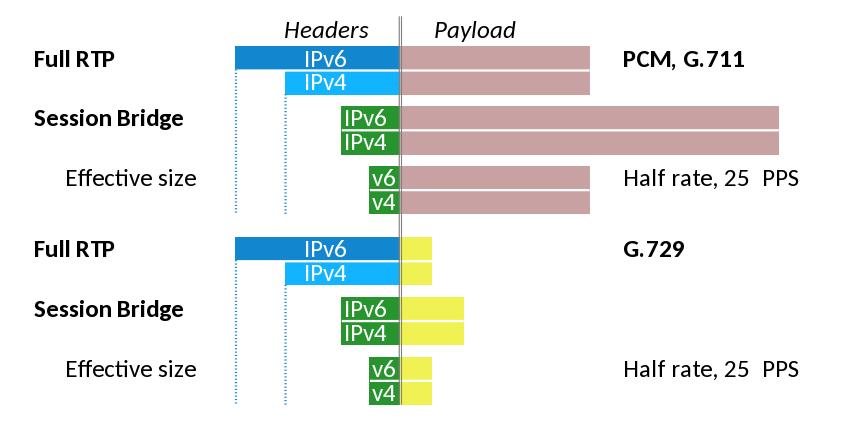
Figure
1:
The Session Bridge replaces the full headers with
smaller bridge
tags. Two payloads per packet at 25 packets per second
reduces the
effective size of both header and payload.
To forward packets
without
traditional headers, session bridging splits the
traditional single
session between end devices (e.g., two phones) into two
bridged
sessions. As packets enter a Session Bridge appliance,
sessions
terminate there. A separate session (VoIP/LAN) extends
from the
far-end appliance to the end device, placing new headers
on each
exiting payload. While on the network, the packet is
guided using
only the tag (MPLS label, virtual circuit identifier, or
Ethernet
address). Appliances hide the bridging operation from
the
end-customer equipment.
To accomplish this
feat, the
Session Bridge instance:
-
Terminates the
session at the Entry appliance which strips the
headers from each packet payload.
-
Transports packet
payloads between appliances on a Label Switched
Path, Virtual Circuit, or Ethernet connection (The
Bridge). Packets have much smaller bridge tags that
direct the packet across the bridge. A Session
Bridge instance acts as a Label Edge Router when it
inserts a bridge tag that includes an MPLS Label.
-
Uses the tag to
ensure the Exit appliance adds the correct headers
as packets leave the appliance toward an end device.
The terms Entry and
Exit refer
to the direction of the flow of packets. Every appliance
acts in
both capacities across two unidirectional bridge
channels to maintain
a full-duplex, bidirectional connection.
The trade-off for
efficiency
from splitting the protocol sessions is the loss of
error correction,
also known as reliable delivery. Because media sessions
can't
replace lost or damaged packets quickly enough to be of
use, nobody
tries. Session bridging has no impact on voice or video.
Reliable
data transport requires TCP or similar protocol,
end-to-end.
Today's routers and
switches
require Ethernet for transport. That is, an Ethernet
header is
required on any packet to cross a link. Recent
announcements of
programmable chips to interface with links means that
legacy Ethernet
requirements no longer need apply. The Session Bridge
process in the
NIC will replace the Ethernet header with a smaller
Layer 2 header. At the link level, software reduces the
header size for every packet,
not limited to streaming media. Separation between
protocol layers
allows both forms of Session Bridge compression to
operate
independently or together.
|